GREEN BAY, Wis. — Distribution can seem archaic at times — even to those within the industry.
Many of its larger players date back decades or longer, and the supplies they provide, although critical to their customers, aren’t perceived as particularly cutting-edge.
But even in the world of nuts, bolts and screws, things can move pretty fast — if they line up correctly, and if the proper foundation to support them is in place.
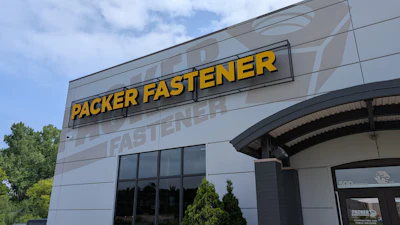
Over its first 20 years in business, Packer Fastener grew from a Green Bay startup to a fastener and industrial supply distributor with multiple locations across Wisconsin — a successful trajectory, to be sure, but not one that would necessarily be unheard of in the industry.
The company – named, like many in the area, in a nod to the local NFL team – began expanding outside its home state in 2021, then added more facilities in the Upper Midwest in subsequent years. During just the last two years, however, dramatic changes in the construction market allowed the company to grow much further and faster: by the end of this year, its footprint will span from the Southeast to the Ohio Valley to the Intermountain West.
 Andy Szal/Industrial Distribution
Those priorities, they added, are also the reason that Packer is ready to set up shop in those new markets for the long haul, whatever the ebbs and flows of the industry may bring in the coming years.
“We’re a 28-year overnight success,” joked Terry Albrecht, the company’s co-founder and CEO.
Expanding Footprint — and Sales
Packer Fastener’s shift beyond the Upper Midwest began in earnest in the spring of 2024, when the company announced the opening of a new branch in suburban Kansas City.
 Andy Szal/Industrial Distribution
“We performed very well on that job site,” Albrecht said. “We learned a lot about the construction industry, and the products that were used, and the value that we could bring to that space.”
Until that time, Packer’s sales had been split about evenly between manufacturing and construction, but the Kansas City project also happened to coincide with the beginning of a building boom in an adjacent segment: data centers.
“We started to be asked to take on more opportunities, and so we kept capitalizing on them,” Albrecht said. “And it’s just kind of snowballed over, literally, the last two years.”
Months after opening its Kansas branch, the company credited an “enthusiastic reception” in the state for the opening of a distribution center in the Kansas City suburbs — its first outside Green Bay. That was followed by additional distribution hubs in Columbus, Ohio, suburban Atlanta and central Mississippi, along with a new branch in Iowa. This year, it has opened yet another distribution center near Indianapolis, and, Albrecht said, would add new ones in Utah, Alabama, Nebraska and Iowa before the end of this year.
And the growth isn’t just geographical: Albrecht said that the company’s sales in its distribution business have grown from $50 million two years ago to a projected $130 million this year.
A Unique Expansion Model
Albrecht conceded that Packer has benefited from “a bit of being in the right place at the right time,” but said that an expansion of that magnitude was only possible thanks to years of “building a strong infrastructure and foundation for the company to scale and grow.”
Albrecht began his distribution career at Fastenal, another Midwestern fastener distributor, after meeting with company reps at a tech school job fair, but although he loved the industry, he was entrepreneurial by nature — and soon soured on the idea of solely pursuing quarterly shareholder value. In 1998, Albrecht and two fellow Fastenal sales reps founded Packer and launched the business from a then-empty 1,600-square-foot building.
 Andy Szal/Industrial Distribution
At each new branch and distribution center, Packer enlists a handful of current employees already well-versed in the company’s culture to replicate that model at the new location.
“We’re saying, ‘We’re going to Indianapolis: whose hand’s up, coming next?’” said Jason Ledvina, the company’s first new hire in 2001 and, today, its president. “You get a few hands in the air. … It’s your own entrepreneurial pathway.”
“We don’t hire leadership positions from outside,” Albrecht said. “We promote exclusively from within, unless it’s like a CFO, right? I can’t teach a CFO how to do his job, but we can teach most of our frontline team members how to do almost every other role in the organization.”
That expansion model, coupled with Packer’s status as a privately owned company, has also enabled the company to make expansion decisions much more quickly than potential rivals in a rapidly evolving industry.
“Our current cadence now is, typically, from [an initial] opportunity in a new location to being opened, and that means fully staffed and inventory, in about six weeks,” Albrecht said. “I don’t think our competitors can negotiate a lease in six weeks, and we’re already operating.”
 Andy Szal/Industrial Distribution
Albrecht characterized it as “one-punch, two-punch diversification;” he estimated that the data center market would have five to 10 years before a plateau or slowdown, but that Packer’s traditional manufacturing expertise would help sustain those operations over the long term. Moreover, he said, both of Packer’s end markets are also becoming increasingly interconnected.
“Construction and manufacturing are starting to melt together, because they’re doing more and more pre-fabrication off-site — pre-making as much of the build as they can, and then shipping it to the job site and putting it together,” Albrecht said.
A New Home — Finally
The boom in business also comes just as Packer Fastener finally has a home to itself.
 Andy Szal/Industrial Distribution
Although most of the building is already in use by Packer, the company believes it has some “runway” before it will need to look for a new place — primarily because most of its warehouse growth will come from its newly opened and pending locations.
 Andy Szal/Industrial Distribution
“You’re taking something that might have historically taken five minutes, and you’re turning it into 30 seconds,” Albrecht said.
Meanwhile, each department within Packer has dozens of AI initiatives in the works, and company leaders talk about doubling productivity while maintaining its current headcount in Northeast Wisconsin.
“The feedback’s coming in, and, now, we’re expanding it out,” Ledvina said. “It’s going well, but it’s making sure we keep the drive, keep the initiative, keep the optimism.”
Like all companies wrestling with AI, deploying the technology across Packer’s operations will require its employees to buy in — something it says it’s uniquely prepared for. The same culture that allowed Packer Fastener to capitalize on rapidly changing industry trends, its leaders believe, will also allow it to take advantage of accelerating technological capabilities.
“We’re very quick to react,” Albrecht said. “That’s just the spirit of our culture and our company.”
 Andy Szal/Industrial Distribution
This article originally appeared in the July/August issue of Industrial Distribution magazine. Sign up here to subscribe to ID’s Today in Industrial Distribution daily newsletter.